Do I have postpartum depression?
Anna
Mother
Continuous support during pregnancy and the year after delivery — behavioral health, lactation, nutrition, and specialty care, included with your Medicaid or commercial insurance. Most patients pay $0.
Do I have postpartum depression?

Anna
Mother
Is my amount of bleeding normal?

Grace
Mother

Continuous support during pregnancy and the year after delivery — behavioral health, lactation, nutrition, and specialty care, included with your Medicaid or commercial insurance. Most patients pay $0.
Do I have postpartum depression?
Anna
Mother
Is my amount of bleeding normal?
Grace
Mother
Continuous support during pregnancy and the year after delivery — behavioral health, lactation, nutrition, and specialty care, included with your Medicaid or commercial insurance. Most patients pay $0.
Do I have postpartum depression?
Anna
Mother
Is my amount of bleeding normal?
Grace
Mother
Pregnancy and the year after delivery is the most medically consequential year in most parents' lives. It's also the year when American healthcare is least present. Your OB sees you for prenatal visits, your delivery, and a single postpartum checkup. After that, you're on your own — sent home with a newborn, recovering from labor, navigating breastfeeding and sleep and your own mental health, with no clinical team paying attention until something goes wrong.
The data is clear about what happens in that gap. Most pregnancy-related deaths in the United States are preventable. Most happen after delivery, in the weeks and months when no one is checking in. Mental health concerns surface late and often go unscreened. Hypertension and other postpartum complications are missed because there's no system designed to catch them.
We built Phia because this gap shouldn't exist. The same continuous attention you'd want for any other high-risk medical year — a transplant recovery, a cancer treatment plan, a cardiac rehab — should exist for pregnancy and the postpartum year. It hasn't, and patients have paid for it.
Phia is what continuous perinatal care looks like.
Pregnancy and the year after delivery is the most medically consequential year in most parents' lives. It's also the year when American healthcare is least present. Your OB sees you for prenatal visits, your delivery, and a single postpartum checkup. After that, you're on your own — sent home with a newborn, recovering from labor, navigating breastfeeding and sleep and your own mental health, with no clinical team paying attention until something goes wrong.
The data is clear about what happens in that gap. Most pregnancy-related deaths in the United States are preventable. Most happen after delivery, in the weeks and months when no one is checking in. Mental health concerns surface late and often go unscreened. Hypertension and other postpartum complications are missed because there's no system designed to catch them.
We built Phia because this gap shouldn't exist. The same continuous attention you'd want for any other high-risk medical year — a transplant recovery, a cancer treatment plan, a cardiac rehab — should exist for pregnancy and the postpartum year. It hasn't, and patients have paid for it.
Phia is what continuous perinatal care looks like.
WHOLE-YEAR CARE
Four categories of care, delivered by one team alongside your OB, across the full perinatal year. The medical, the practical, and everything in between.
Four categories of care, delivered by one team alongside your OB, across the full perinatal year. The medical, the practical, and everything in between.




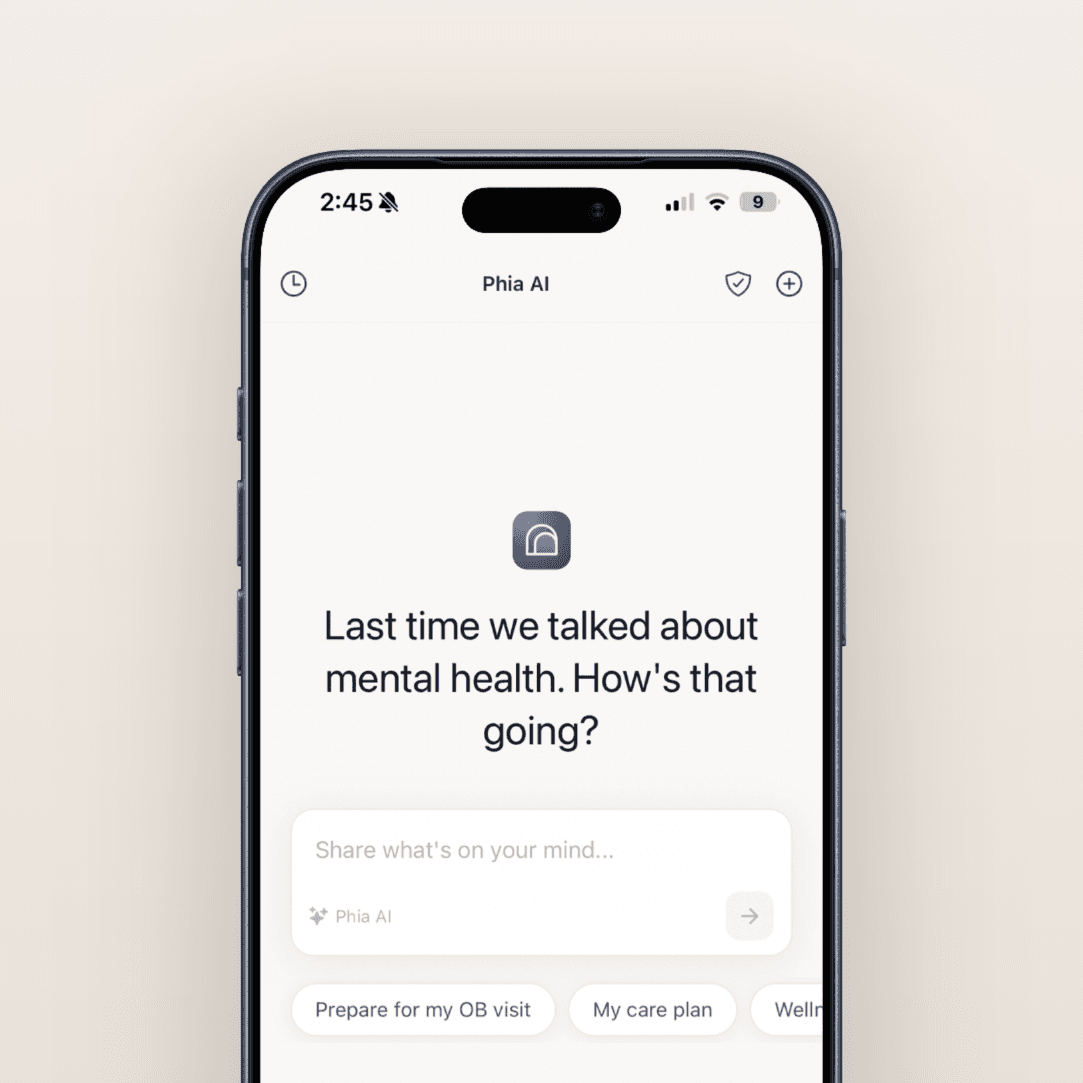
Your OB stays your medical home through your delivery — we coordinate with your practice on your plan and your recovery. After you go home, your Phia care coordinator reaches out within days to make sure you're recovering well and to connect you with lactation support if feeding is hard.
Your OB stays your medical home through your delivery — we coordinate with your practice on your plan and your recovery. After you go home, your Phia care coordinator reaches out within days to make sure you're recovering well and to connect you with lactation support if feeding is hard.
Continuous care from your first visit through 12 months postpartum. Here's what it looks like across the year.
You meet your care coordinator within days of signing up. Together you walk through your health history, what kind of support you want, and what to expect. From there your care team is available by message anytime — for the questions that come up between visits, the symptoms you're not sure are normal, the appointments you're trying to figure out how to schedule. Mental health screening at the cadence ACOG recommends. Nutrition support if your OB flags it. Lactation planning before delivery if you want it.
We coordinate with your OB practice through your delivery. After you go home, your care coordinator reaches out to make sure you're recovering well and connect you with lactation support if feeding is hard. Postpartum depression screening within the first weeks. Help with the questions nobody warns you about — bleeding, sleep, feeding, your own mental health, your baby's. Real clinicians, not a chat tool, available when you need them.
The hardest part of postpartum is often what happens months three through twelve, when the rest of the world has moved on but you're still recovering. Phia stays with you through it. Continued mental health support if you need it. Pelvic floor recovery referrals when your body is ready. Help finding a therapist or psychiatrist if your screening flags concerns. Connection to community resources for childcare, food, or housing. We keep checking in until your year is done.
Continuous care from your first visit through 12 months postpartum. Here's what it looks like across the year.
You meet your care coordinator within days of signing up. Together you walk through your health history, what kind of support you want, and what to expect. From there your care team is available by message anytime — for the questions that come up between visits, the symptoms you're not sure are normal, the appointments you're trying to figure out how to schedule. Mental health screening at the cadence ACOG recommends. Nutrition support if your OB flags it. Lactation planning before delivery if you want it.
We coordinate with your OB practice through your delivery. After you go home, your care coordinator reaches out to make sure you're recovering well and connect you with lactation support if feeding is hard. Postpartum depression screening within the first weeks. Help with the questions nobody warns you about — bleeding, sleep, feeding, your own mental health, your baby's. Real clinicians, not a chat tool, available when you need them.
The hardest part of postpartum is often what happens months three through twelve, when the rest of the world has moved on but you're still recovering. Phia stays with you through it. Continued mental health support if you need it. Pelvic floor recovery referrals when your body is ready. Help finding a therapist or psychiatrist if your screening flags concerns. Connection to community resources for childcare, food, or housing. We keep checking in until your year is done.
Continuous care from your first visit through 12 months postpartum. Here's what it looks like across the year.
You meet your care coordinator within days of signing up. Together you walk through your health history, what kind of support you want, and what to expect. From there your care team is available by message anytime — for the questions that come up between visits, the symptoms you're not sure are normal, the appointments you're trying to figure out how to schedule. Mental health screening at the cadence ACOG recommends. Nutrition support if your OB flags it. Lactation planning before delivery if you want it.
We coordinate with your OB practice through your delivery. After you go home, your care coordinator reaches out to make sure you're recovering well and connect you with lactation support if feeding is hard. Postpartum depression screening within the first weeks. Help with the questions nobody warns you about — bleeding, sleep, feeding, your own mental health, your baby's. Real clinicians, not a chat tool, available when you need them.
The hardest part of postpartum is often what happens months three through twelve, when the rest of the world has moved on but you're still recovering. Phia stays with you through it. Continued mental health support if you need it. Pelvic floor recovery referrals when your body is ready. Help finding a therapist or psychiatrist if your screening flags concerns. Connection to community resources for childcare, food, or housing. We keep checking in until your year is done.
A 30-minute capabilities briefing walks through the care model, how a partnership operates in practice, and a population-specific impact estimate built on your gap data.
Phia is a 2026 grantee of the Perinatal Action Collaborative — a Pennsylvania initiative to advance maternal health outcomes.
Phia is a 2026 grantee of the Perinatal Action Collaborative — a Pennsylvania initiative to advance maternal health outcomes.