Phia Updates
Closing the Loop on Social Needs: Phia Launches AI-Driven SDOH Resource Matching
Phia now includes an AI-powered SDOH resource matching system that identifies social needs at intake, matches patients to verified local resources, and delivers those connections directly inside the care relationship — without requiring a care coordinator to search, and without requiring the patient to figure it out alone.

Renee Jones, RN
Most pregnancy complications don't announce themselves in the exam room. They surface in the quiet weeks between visits — a screening that never got completed, a referral that didn't happen, a patient who stopped responding.
A lot of that silence has a social root. Food insecurity. Unstable housing. No way to get to an appointment. A new baby and no childcare. These aren't peripheral to maternal health — they're central to it. And for too long, connecting patients to the resources that address them has depended on a care coordinator having the right phone number memorized, a paper handout that may or may not still be accurate, or a patient with the bandwidth to navigate a directory on her own.
Today, Phia is changing that.
Introducing SDOH Resource Matching
Phia now includes an AI-powered SDOH resource matching system that identifies social needs at intake, matches patients to verified local resources, and delivers those connections directly inside the care relationship — without requiring a care coordinator to search, and without requiring the patient to figure it out alone.
Here's how it works.
Patients tell us what they need. At onboarding, patients see a simple, preference-style selection: What can we help you with? Food assistance. Getting to appointments. Housing. Baby supplies. Childcare. Benefits enrollment. Mental health support. It takes ten seconds and feels like setting up a profile, not filling out a form.
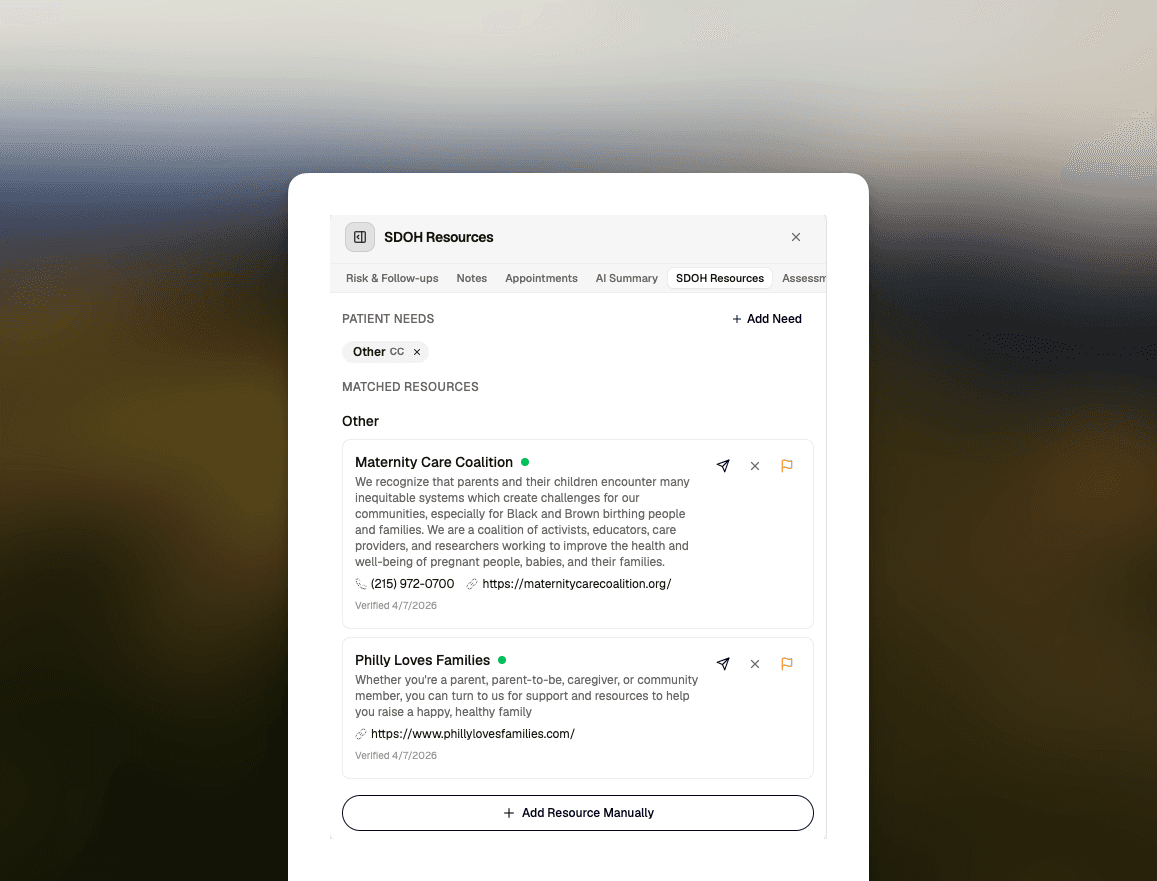
An agent does the matching. Behind the scenes, Phia's SDOH agent continuously crawls Pennsylvania's public data sources — feeding networks, WIC-capable health centers, county assistance offices, drug and alcohol programs, childcare providers — and maintains a verified, structured database of over 500 resources across the state. When a patient selects a need, the agent reads her zip code and need profile and pre-populates a matched resource bundle in her care coordinator's workflow. No searching. The matches are already there.
Care coordinators deliver with one tap. The coordinator reviews the pre-populated recommendations, taps to send, and the patient receives a structured resource card inside her existing care conversation — program name, phone number, address, hours. One tappable action. The need identified, the resource delivered, the loop closed. All of it documented.
Why an Agent, Not an API
We considered the standard approach: purchase access to an SDOH aggregator's database and integrate their API. It's how most platforms handle this.
We chose not to, for a specific reason. The aggregators sell a phone book. We wanted to build a recommendation engine — one that gets smarter over time and generates insights no centralized database can replicate.
Phia's agent operates differently from a static directory in three ways.
It learns from the field. When a care coordinator flags a dead resource, that signal propagates instantly. The resource is quarantined from future matches and queued for re-verification. When a resource gets sent repeatedly and confirmed, that acceptance signal re-ranks it in future recommendations. The knowledge that usually lives in individual care coordinators' heads — who to call, what to expect, what actually gets patients connected — starts to compound in the system itself.
It's continuously fresh. The agent re-crawls its sources weekly, running automated liveness checks on every resource record. Dead phone numbers and closed programs drop out of the recommendation set automatically, without anyone having to notice and correct it.
It's perinatal-specific. Phia's resource set isn't 50,000 entries a care coordinator has to sift. It's a curated, high-confidence set of Pennsylvania resources mapped to the actual needs of pregnant and postpartum patients: WIC enrollment, prenatal care access, feeding sites within reach, early childcare for the return-to-work transition, benefits programs that matter at this stage of life. Smaller, sharper, higher signal.
The Closed Loop MCOs Have Been Asking For
Every MCO conversation Phia has had over the past year has included some version of the same request: show us that social needs are being addressed, not just screened.
Screening is table stakes. What payers need for HEDIS reporting, CMS compliance, and value-based contracts is documentation that a need was identified, a resource was delivered, and the loop was closed. That's exactly what this system produces — at the patient level, in real time, across the full panel.
For Medicaid managed care organizations covering pregnant and postpartum members in Pennsylvania, Phia can now report: need identified at intake, resource matched within hours, resource delivered through the care relationship, outcome flagged when the CC follows up. Every step timestamped. Every action attributed. Every data point reportable.
That's not a SDOH feature. That's a quality metric.
What's Live Today
Phia's SDOH system launched with verified coverage across four categories:
288 food resources — including 304 Philabundance-network feeding sites and 61 WIC-capable Pennsylvania State Health Centers
123 benefits resources — County Assistance Offices and PA CareerLink locations statewide, covering SNAP, Medicaid enrollment, and employment assistance
120 mental health resources — county drug and alcohol programs and public health centers across all 67 Pennsylvania counties
Perinatal-specific resources — manually curated entries from organizations like Maternity Care Coalition, with CC-contributed records expanding over time
Coverage for housing, transportation, and baby supplies — categories where open public data doesn't exist — is in active development through a 211 data partnership and a care coordinator annotation layer that allows the team to contribute field knowledge directly.
What Comes Next
The current system does reactive matching: a patient selects a need, resources appear. The next iteration flips the model. Phia's agent will monitor every patient's panel continuously — and when a new program opens, or a patient's situation changes, the system will push a notification to the care coordinator: three of your patients may now qualify for this. The work finds the CC, not the other way around.
Further out, as the resource graph matures and the agent accumulates field-validated operational knowledge, the system moves toward full agentic outreach — the agent contacts the resource on the patient's behalf, handles intake, confirms eligibility, and reports back. The patient doesn't make a cold call. The CC doesn't research. The connection happens.
That's the version we're building toward. The foundation is now live.
Phia Health is an AI-powered perinatal care platform operating across Pennsylvania, serving patients, OB practices, and Medicaid managed care organizations. For partnership inquiries, contact us at partners@phia.care.
How designers estimate the impact of UX?
Closing the Loop on Social Needs: Phia Launches AI-Driven SDOH Resource Matching
Closing the Loop on Social Needs: Phia Launches AI-Driven SDOH Resource Matching
Phia now includes an AI-powered SDOH resource matching system that identifies social needs at intake, matches patients to verified local resources, and delivers those connections directly inside the care relationship — without requiring a care coordinator to search, and without requiring the patient to figure it out alone.
Phia now includes an AI-powered SDOH resource matching system that identifies social needs at intake, matches patients to verified local resources, and delivers those connections directly inside the care relationship — without requiring a care coordinator to search, and without requiring the patient to figure it out alone.
Renee Jones, RN
Published in Fintech
Phia Updates
Image credit by Yum Yum
Most pregnancy complications don't announce themselves in the exam room. They surface in the quiet weeks between visits — a screening that never got completed, a referral that didn't happen, a patient who stopped responding.
A lot of that silence has a social root. Food insecurity. Unstable housing. No way to get to an appointment. A new baby and no childcare. These aren't peripheral to maternal health — they're central to it. And for too long, connecting patients to the resources that address them has depended on a care coordinator having the right phone number memorized, a paper handout that may or may not still be accurate, or a patient with the bandwidth to navigate a directory on her own.
Today, Phia is changing that.
Introducing SDOH Resource Matching
Phia now includes an AI-powered SDOH resource matching system that identifies social needs at intake, matches patients to verified local resources, and delivers those connections directly inside the care relationship — without requiring a care coordinator to search, and without requiring the patient to figure it out alone.
Here's how it works.
Patients tell us what they need. At onboarding, patients see a simple, preference-style selection: What can we help you with? Food assistance. Getting to appointments. Housing. Baby supplies. Childcare. Benefits enrollment. Mental health support. It takes ten seconds and feels like setting up a profile, not filling out a form.
An agent does the matching. Behind the scenes, Phia's SDOH agent continuously crawls Pennsylvania's public data sources — feeding networks, WIC-capable health centers, county assistance offices, drug and alcohol programs, childcare providers — and maintains a verified, structured database of over 500 resources across the state. When a patient selects a need, the agent reads her zip code and need profile and pre-populates a matched resource bundle in her care coordinator's workflow. No searching. The matches are already there.
Care coordinators deliver with one tap. The coordinator reviews the pre-populated recommendations, taps to send, and the patient receives a structured resource card inside her existing care conversation — program name, phone number, address, hours. One tappable action. The need identified, the resource delivered, the loop closed. All of it documented.
Why an Agent, Not an API
We considered the standard approach: purchase access to an SDOH aggregator's database and integrate their API. It's how most platforms handle this.
We chose not to, for a specific reason. The aggregators sell a phone book. We wanted to build a recommendation engine — one that gets smarter over time and generates insights no centralized database can replicate.
Phia's agent operates differently from a static directory in three ways.
It learns from the field. When a care coordinator flags a dead resource, that signal propagates instantly. The resource is quarantined from future matches and queued for re-verification. When a resource gets sent repeatedly and confirmed, that acceptance signal re-ranks it in future recommendations. The knowledge that usually lives in individual care coordinators' heads — who to call, what to expect, what actually gets patients connected — starts to compound in the system itself.
It's continuously fresh. The agent re-crawls its sources weekly, running automated liveness checks on every resource record. Dead phone numbers and closed programs drop out of the recommendation set automatically, without anyone having to notice and correct it.
It's perinatal-specific. Phia's resource set isn't 50,000 entries a care coordinator has to sift. It's a curated, high-confidence set of Pennsylvania resources mapped to the actual needs of pregnant and postpartum patients: WIC enrollment, prenatal care access, feeding sites within reach, early childcare for the return-to-work transition, benefits programs that matter at this stage of life. Smaller, sharper, higher signal.
The Closed Loop MCOs Have Been Asking For
Every MCO conversation Phia has had over the past year has included some version of the same request: show us that social needs are being addressed, not just screened.
Screening is table stakes. What payers need for HEDIS reporting, CMS compliance, and value-based contracts is documentation that a need was identified, a resource was delivered, and the loop was closed. That's exactly what this system produces — at the patient level, in real time, across the full panel.
For Medicaid managed care organizations covering pregnant and postpartum members in Pennsylvania, Phia can now report: need identified at intake, resource matched within hours, resource delivered through the care relationship, outcome flagged when the CC follows up. Every step timestamped. Every action attributed. Every data point reportable.
That's not a SDOH feature. That's a quality metric.
What's Live Today
Phia's SDOH system launched with verified coverage across four categories:
288 food resources — including 304 Philabundance-network feeding sites and 61 WIC-capable Pennsylvania State Health Centers
123 benefits resources — County Assistance Offices and PA CareerLink locations statewide, covering SNAP, Medicaid enrollment, and employment assistance
120 mental health resources — county drug and alcohol programs and public health centers across all 67 Pennsylvania counties
Perinatal-specific resources — manually curated entries from organizations like Maternity Care Coalition, with CC-contributed records expanding over time
Coverage for housing, transportation, and baby supplies — categories where open public data doesn't exist — is in active development through a 211 data partnership and a care coordinator annotation layer that allows the team to contribute field knowledge directly.
What Comes Next
The current system does reactive matching: a patient selects a need, resources appear. The next iteration flips the model. Phia's agent will monitor every patient's panel continuously — and when a new program opens, or a patient's situation changes, the system will push a notification to the care coordinator: three of your patients may now qualify for this. The work finds the CC, not the other way around.
Further out, as the resource graph matures and the agent accumulates field-validated operational knowledge, the system moves toward full agentic outreach — the agent contacts the resource on the patient's behalf, handles intake, confirms eligibility, and reports back. The patient doesn't make a cold call. The CC doesn't research. The connection happens.
That's the version we're building toward. The foundation is now live.
Phia Health is an AI-powered perinatal care platform operating across Pennsylvania, serving patients, OB practices, and Medicaid managed care organizations. For partnership inquiries, contact us at partners@phia.care.

You don't have to figure this out alone.
Whether it's 2pm or 2am, your care team is here. Real maternal health experts. Real answers. Real support. Get started today—most families pay $0 with insurance.
You don't have to figure this out alone.
Whether it's 2pm or 2am, your care team is here. Real maternal health experts. Real answers. Real support. Get started today—most families pay $0 with insurance.
You don't have to figure this out alone.
Whether it's 2pm or 2am, your care team is here. Real maternal health experts. Real answers. Real support. Get started today—most families pay $0 with insurance.